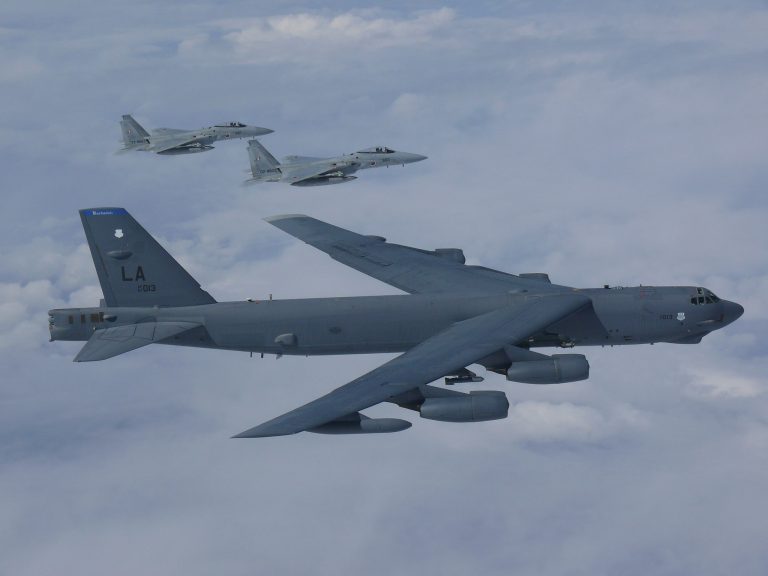
U.S. B-52 strategic bombers and Japanese fighter jets participated in a joint military exercise on Wednesday in a major show of force following recent tension between China and Japan.
According to The Associated Press, the Japanese Joint Staff confirmed that the U.S. military and Japan’s Air Self-Defense Force held a joint military exercise on Wednesday in light of the current “security environment” surrounding Japan, which the Japanese Joint Staff claimed was “becoming even severer.” The Japanese Joint Staff said that the two countries “reaffirmed the strong resolve to prevent unilateral attempts to change the status quo by force and the readiness between the SDF and the U.S. forces.”
The Associated Press reported that officials said the joint military drills involved two U.S. B-52 strategic bombers, three Japanese F-15 fighter jets, and three Japanese F-35 stealth fighter jets and were held near Japan’s western airspace between Japan and South Korea. The outlet noted that Wednesday’s joint military drill came just one day after Russian and Chinese bombers conducted a joint flight between Japan and South Korea.
According to The Associated Press, two Chinese H-6 bombers and two Russian Tu-95 strategic bombers flew over the East China Sea and down toward the southern coast of Shikoku, a Japanese island, on Tuesday. The four Chinese and Russian bombers were also joined by four Chinese J-16 fighters as the bombers flew between the Japanese islands of Okinawa and Miyako, according to the outlet.
READ MORE: China labels US, Japanese destroyers as ‘enemy vessels’
NPR reported that Tuesday’s joint flight by Russia and China forced Japan and South Korea to scramble aircraft to monitor the bombers and fighter jets.
According to The Associated Press, Tuesday’s incident comes after Japan claimed that its fighter jets were repeatedly targeted by radar locking as the fighter jets were monitoring Chinese drills near the southern region of Japan last month.
The Associated Press reported that the Japanese Ministry of Defense confirmed that Secretary of War Pete Hegseth and Japanese Defense Minister Shinjiro Koizumi had a phone call discussion on Friday regarding an “increasingly severe security situation in the Indo-Pacific region, including the radar incident.”
NPR confirmed that while President Donald Trump’s administration had previously refrained from criticizing China over its recent dispute with Japan, the U.S. State Department told the outlet that China’s actions were “not conducive to regional peace and stability.”
“The U.S.-Japan Alliance is stronger and more united than ever,” the State Department stated. “We remain unwaveringly committed to our ally Japan and are in close contact.”